
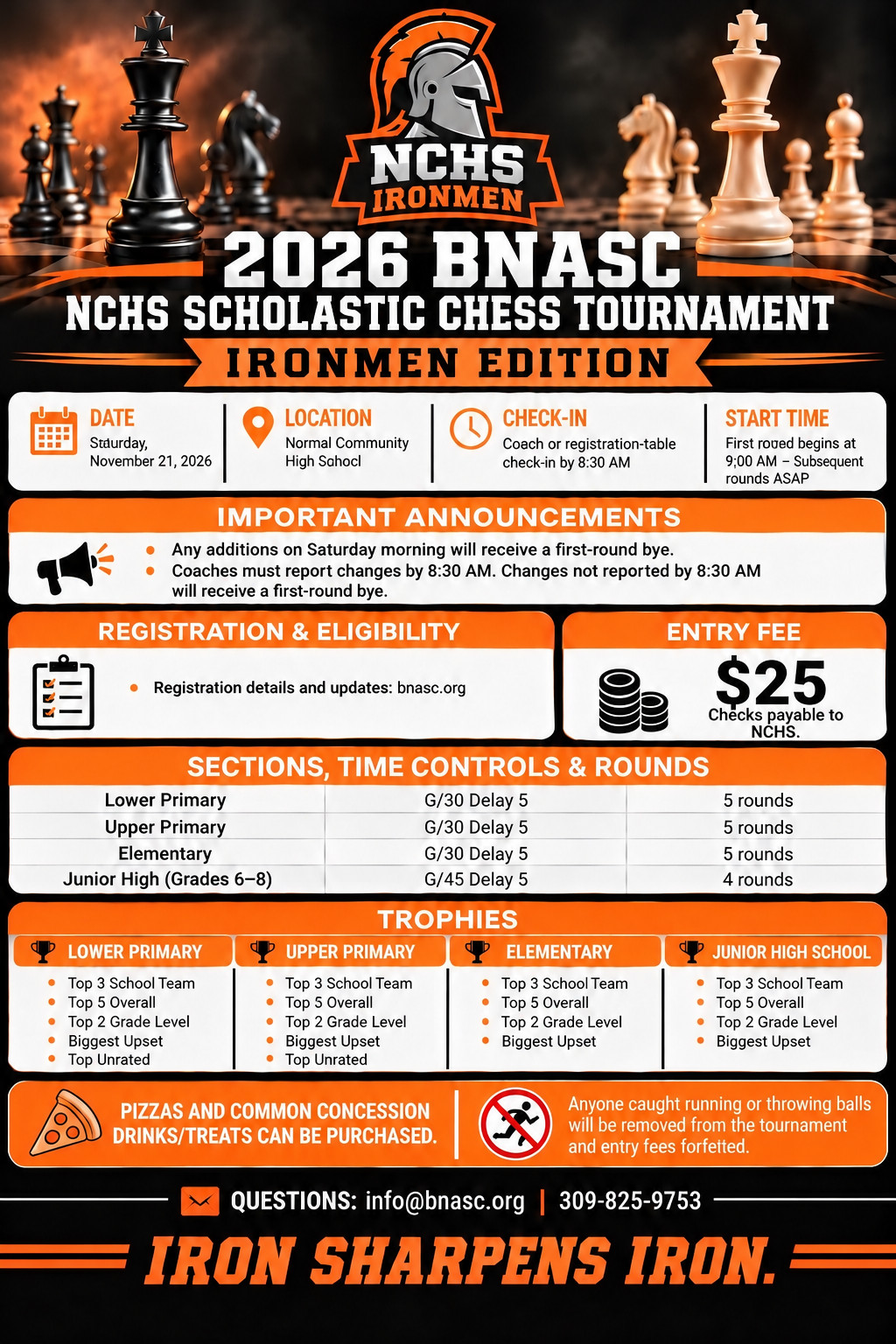
2026 NCHS SCHOLASTIC CHESS TOURNAMENT
QUESTIONS: This email address is being protected from spambots. You need JavaScript enabled to view it.
USCF Chess Memberships 2026

United States Chess Federation (USCF) memberships are required for all rated BNASC tournaments. In previous years we allowed Junior Tournament Player (JTP) membership which allowed for K-3 players to play without a membership. These players were assigned non-member USCF player id’s. For the 2026-2027 season we will be requiring all players to have a paid, not expired, membership to play in Lower Primary, Upper Primary, Elementary and Junior High sections. Parents will be required to ensure the players membership status is current prior to attending the tournament. If your membership is expired, you will need to renew your membership no later than the Thursday before the tournament. This will give the tournament organizers time to validate all players membership status. Failure to have a valid membership before the day of the tournament could result in a first round bye until membership status is resolved. If you’ve played in any of our past tournaments, you have a USCF membership id. It is important to RENEW your existing membership to maintain your player rating and not create a new membership.
For some select tournaments, a ‘Beginner’ section will be available for K-3 non-members who would like to try a tournament without a paid membership. A USCF Id is not need for this section. This section will be unrated and will not count towards a player rating.
To find your player’s USCF ID
- Visit https://new.uschess.org/
- Select Ratings / Player Ratings Lookup
- Enter your players name
- Select your players name
- review the tournament history to ensure you have the correct player.
- Save off your USCF ID
What do I do if my player has multiple USCF ID’s?
- Reach out to Korey Kormick at US Chess. This email address is being protected from spambots. You need JavaScript enabled to view it.
To Renew your membership
- Visit https://new.uschess.org/
- Select the JOIN / RENEW menu option
- If you already have an account, login
- If you have a USCF Id but don’t have an account yet
- Select Returning Members
- create your user login here
New players who have never played a local or USCF Rated chess tournament
- Visit https://new.uschess.org/
- Select the JOIN / RENEW menu option
- Select New First Time Members
How do Individual Tie Breaks Work?
Tiebreak Systems Overview
1. Modified Median System
- Definition: Used when players tie with an even score (exactly half of the maximum possible score).
- How it works:
- For players with even scores: Exclude both the highest- and lowest-scoring opponents’ scores.
- For players with non-even scores:
- If tied with a plus score: Disregard only the lowest-scoring opponent’s score.
- If tied with a minus score: Disregard only the highest-scoring opponent’s score.
2. Solkoff System
- Definition: Similar to the Median system, but no opponents’ scores are discarded. All opponents’ scores are included in the calculation.
3. Cumulative System
- Definition: Adds up the cumulative (running) score for each round.
- How it works:
- Example: If a player’s results are win, loss, win, draw, loss, the cumulative scores per round would be 1, 1, 2, 2.5, 2.5. The total is 9 (1+1+2+2.5+2.5).
- If another player’s sequence is 1, 2, 2.5, 2.5, 2.5, the total is 10.5 (1+2+2.5+2.5+2.5).
- The player who scores earlier generally has a higher tiebreak, as they likely faced tougher opposition later.
- Adjustments:
- Subtract 1 point for each unplayed win or full-point bye.
- Subtract 0.5 point for each unplayed draw or half-point bye.
4. Cumulative of Opposition
- Definition: Calculate the cumulative tiebreak points for each opponent (as above), then sum these values for all opponents.